
How to Clean Up Suno Audio — Free Preview, Step by Step
Open the free preview, upload audio, process it and compare the original with the 30-second cleanup preview.
Practical guides for producers, labels and distributors: cleaning artifacts out of AI-generated music, telling whether a track was AI-generated, and repairing stems and mixes. For one-click AI music artifact removal on a master bus, see the de-artifact plug-in. Start with a topic, or browse every post below, newest first.
Watch tutorials & demos ↓Hear the comparisons on YouTube, then use the written guides to try the workflow on your own audio. These are public videos from the Intrect channel.
Open the free preview, upload audio, process it and compare the original with the 30-second cleanup preview.
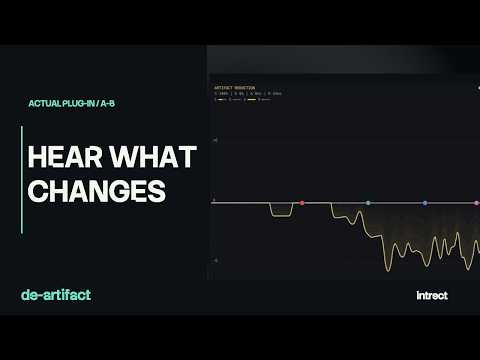
Compare bypass and processing across mixes, separated stems and older samples, including the model residual and Nicerizer controls.

A short bypass/processed comparison on an older beatbox sample. Listen for what changes before choosing a processing amount.
Pair these listening comparisons with the Suno artifacts guide.
Read the stem cleanup guide and the instrument bleed guide to distinguish separation residue from bleed.
Hear preset comparisons, then read how dynamic resonance suppression differs from a static notch. These are music comparisons, rather than a demonstration of every vocal-room problem in the guide.
The 17-minute walkthrough in sections: breaks, full mixes, stems, high-frequency reconstruction and latency, with what to listen for and links to each chapter.
One markets getting tracks past distributor AI checks, the other is built to improve how they sound. Purpose, formats and price, quoted from public pages.
What a dedicated plug-in, an open-source script, a repair suite and an EQ each fix, where they run, and where our own tool is the wrong choice.
Why generated metal turns fizzy and smeared, why cutting the top end backfires, and a per-stem workflow that keeps pick attack and cymbal body.
The buyer's view of the same 2,104-file comparison — what each tool suits, why a ranking alone cannot answer the question, and what the results do not prove.
ArtifactNet has expanded validated detection coverage to Suno v6 and ACE-Step 1.5. The updated model is live now.
A controlled 2,104-file comparison, the false-positive behavior hidden by F1, and the limits a ranking cannot answer.
How to diagnose and clean watery, metallic or smeared artifacts in Udio audio you already have locally, with a current note on download availability.
Why drums and accompaniment remain inside isolated vocals, why a level gate struggles, and why bleed should be treated before separation residue.
What each format preserves, why MP3-to-WAV conversion cannot restore lost detail, and which source to use for cleanup or forensic analysis.
A practical workflow for confidence, codec effects, false positives, human escalation, audit records and appeals.
Three mechanisms, three different questions: how rights teams can combine cooperative provenance, embedded marks and forensic evidence.
A stem pulled out of a mix carries two different problems — residue smeared through the signal you kept, and bleed from the instruments around it. How to tell which one you have, and why the order you treat them in matters.
Gates cut the tail and the body with it; EQ notches dull the stick. The ring is harmonic and the stick is percussive — separate them and you can attenuate one without touching the other.
A room resonance only blooms on certain notes, but a static notch cuts that frequency for the whole take. Why a dynamic EQ band gets closer, and what per-bin suppression does differently.
What the metallic shimmer and watery sustains in Suno tracks actually are, why the free plan's MP3 export makes them worse, and which preset to reach for depending on your export format.
Closing the genre gap and the false-positive rate we promised to fix — a ground-up retrain on 27,476 tracks, a borderline-call review model, and the deployment bug we caught mid-rollout.
Negative results, evaluation leakage, and what we measured wrong — three failed experiments, a data-leakage discovery, and the real weakness hiding behind an illusory one.
Distillation and runtime — why light doesn't mean fast. Two parameter-count inversions, a causal real-time UNet, and a 50x speedup from a single ONNX surgery.
Listening cues, spectrogram analysis, and automated forensic tools for identifying AI-generated music from Suno, Udio, Stable Audio, and more. Includes benchmark comparison.
Step-by-step guide to removing the metallic, watery, swirly artifacts from AI-generated music. Covers RVQ ghosting, codec residue, and HF aliasing — what they are and how to fix them.
Chasing SONICS scores while real-world performance collapses — how a benchmark-saturated model went from SOTA to a 4.3% detection rate on the newest generator, and the fair-comparison harness we built in response.